
Special VFR: When Is It Actually Useful?
The aerodrome reports good visibility and a cloud ceiling of 1,200 ft. The surrounding country is flat, the weather is stable, and your intended route appears comfortably flyable. Yet the conditions are below the ceiling threshold for an ordinary VFR departure from an aerodrome within a control zone. This is the kind of situation in which special VFR deserves a closer look.
Special VFR, usually shortened to SVFR, allows air traffic control to authorise a visual flight within a control zone under specific conditions. It can help with a local arrival, departure or transit. Its usefulness depends on the actual route and your ability to keep flying safely by outside visual reference.
For a private pilot, understanding the numbers is the beginning. The more demanding question is whether the flight leaves enough room to handle an unexpected change. A clearance can arrive in a few words on the radio. Assessing the weather ahead takes considerably more thought.
Contents
What special VFR allows
A control zone, or CTR, is controlled airspace extending upwards from the surface to a specified upper limit. Special VFR applies within that zone and requires an ATC clearance. You must obtain the clearance before beginning the controlled portion of the flight. A request on the radio does not itself authorise entry.
Under the standard European rules, ordinary VFR flights must meet the applicable visibility and cloud-distance requirements. There is also a separate aerodrome condition: without an ATC clearance, VFR flights cannot take off or land at an aerodrome within a control zone, or enter the aerodrome traffic zone or circuit, when the reported ceiling is below 1,500 ft or ground visibility is below five kilometres.
An SVFR clearance can therefore be relevant when visibility remains good but a lower ceiling prevents an ordinary VFR aerodrome operation. It can also be relevant when visibility is below the ordinary VFR requirements. Each case still has to satisfy the SVFR conditions and the other rules applicable to the flight.
The clearance covers the authorised operation within the CTR. Beyond it, you must meet the rules for the airspace you enter. Plan that transition before departure or before requesting a transit. A zone boundary drawn on the chart can change the applicable rules without producing any improvement in the weather outside the window.
The conditions you must maintain
For an aeroplane operating under the Standardised European Rules of the Air (SERA) special VFR provisions, flight visibility must be at least 1,500 metres. You must remain clear of cloud with the surface in sight and fly at 140 knots indicated airspeed or less. The flight is by day unless the competent authority has permitted otherwise.
Flight visibility is what you can see forward from the cockpit in flight. Reported ground visibility describes conditions observed at the aerodrome. Rain on the windscreen, haze and the direction in which you are looking can make the view ahead very different from your impression while standing outside the aircraft. Use identifiable features and the latest weather information when making your assessment.
Remaining clear of cloud means maintaining an outside view throughout the SVFR operation. A visible field directly below the aircraft is little help if cloud obscures the route ahead. Your intended height must provide usable visual reference and sufficient clearance from terrain and obstacles while complying with the applicable minimum-height rules.
The 140-knot limit is an indicated-airspeed maximum. Choose an appropriate speed for the aircraft and conditions, preserving handling margins and time to identify what is ahead. Slowing down may reduce workload, but it cannot make an obscured route visible. A plan that depends on flying progressively slower and lower needs reconsideration while there is still space to do so.
Helicopters have a lower standard flight-visibility threshold of 800 metres, with speed adjusted appropriately to the conditions. Certain specially authorised helicopter operations have additional exceptions. Aeroplane pilots should use the aeroplane requirements, and private pilots should check the permissions applicable to their own operation. A night qualification alone does not establish that local SVFR at night is permitted.

What the 600 ft ceiling requirement means
For an aeroplane taking off or landing at an aerodrome within a CTR, or entering its aerodrome traffic circuit, ATC cannot issue the standard SVFR clearance when reported ground visibility is below 1,500 metres or the reported ceiling is below 600 ft. Both aerodrome conditions must be satisfied. Your flight-visibility obligation also continues to apply.
A ceiling describes the height above the ground or water of the base of the lowest cloud layer below 20,000 ft covering more than half the sky. In an aerodrome weather report, a broken or overcast layer can establish a ceiling. A few small low clouds and a widespread low cloud layer can therefore produce different reported conditions, even when their bases are at similar heights.
The 600 ft figure is a limit on issuing those particular clearances. It gives you no assurance of a suitable cruising height. An aerodrome with a 700 ft ceiling may have rising ground on the departure route, obstacles beneath the cloud or insufficient room for a safe turn. An altimeter setting and a clearance cannot remove those constraints.
The normal minimum-height obligations remain relevant. Except where the take-off or landing exception or competent-authority permission applies, the daytime VFR rules include 1,000 ft above the highest obstacle within 600 metres over congested areas, and the applicable 500 ft ground, water or nearby-obstacle clearance elsewhere. Local requirements may add constraints. Assess the complete route against them.
Why a transit can be different
The aerodrome restrictions in SERA.5010(c) name take-off, landing and entry to the aerodrome traffic circuit within the CTR. A flight crossing the zone without landing or joining that circuit is a different case. This distinction is useful when weather at the aerodrome differs from conditions along the proposed transit route.
EASA guidance specifically explains that ATC may issue a transit SVFR clearance when reported ground visibility at the aerodrome is below 1,500 metres, provided the pilot reports flight visibility of at least 1,500 metres for an aeroplane. The flight must still meet its other conditions. ATC considers the individual request and may be unable to accommodate it.
The 600 ft aerodrome ceiling restriction likewise belongs to the specified aerodrome operations, so avoid treating it as a blanket ceiling rule for every transit. That distinction demands careful route assessment: remaining clear of cloud, maintaining the required heights and complying with local procedures may make a proposed crossing impracticable anyway.
Suppose a patch of fog affects one end of an aerodrome while a route across another part of the zone has adequate flight visibility and cloud clearance for SVFR. A transit may be worth discussing with ATC. If your intention changes to landing, the aerodrome clearance conditions become relevant. Make that change explicit before committing to an arrival.
What ATC does, and what you still decide
ATC handles SVFR requests individually. The controller considers traffic and the applicable separation requirements, as well as the conditions governing the clearance. You may receive a delay, an alternative route or a refusal. Build enough flexibility into the flight to accommodate that response without holding near worsening weather.
The rules provide for separation between IFR flights and SVFR flights, and between SVFR flights unless the competent authority prescribes otherwise. Applicable exceptions and local procedures can affect how separation is provided. Continue a proper lookout and comply with the clearance. Avoid assuming that the words “special VFR” guarantee separation from every aircraft you might encounter.
You remain responsible for assessing terrain clearance and whether you can safely follow the proposed route or level. Tell ATC promptly if an instruction is unsuitable. A restriction that is straightforward on a clear afternoon may leave too little height beneath today's cloud. Explain the difficulty while there is still time for a workable alternative.
Air Law and Meteorology come together here: you need to understand the clearance and judge the conditions in which you would use it. Easy EASA's online theory course and practice exams can help you work through those relationships before you have to make the decision in the cockpit.
When SVFR can be a sensible option
A localised weather restriction with a clearly usable route is the strongest starting point. Consider the opening example: stable cloud at 1,200 ft, good visibility and flat surroundings. An SVFR departure may be practical if the permitted route provides adequate terrain and obstacle clearance, the aircraft can remain clear of cloud, and the onward flight meets its own VFR requirements.
For an arrival, SVFR may allow a controlled aerodrome to remain an option when ordinary VFR conditions are unavailable. Evaluate the whole arrival, including joining and a possible go-around. Meeting the reported aerodrome minima is only one part of that assessment. You need enough room to complete the manoeuvres without losing visual reference or being forced into unsuitable terrain.
A transit can also be useful where conditions along the crossing remain suitable and the alternative route would introduce a different difficulty. Compare the actual options, including the weather along them. A shorter line on the chart offers little benefit if it leaves you uncertain about what is ahead or dependent on a clearance that might be delayed.
These are hypothetical situations, each requiring a fresh assessment. Familiarity with the area can help you recognise landmarks and understand the terrain, but it also makes it easy to assume that a route will look as it did last time. Base the decision on today's view and weather information. Keep a suitable diversion available before making the request.
When the legal option is a poor choice
Deteriorating weather can turn a marginally acceptable route into an unusable one during the time spent requesting and reading back a clearance. Falling cloud over rising ground is particularly unforgiving. If continuing means descending repeatedly to keep the surface in sight, the available space and your choices are already reducing.
Widespread poor visibility creates a different problem. At the legal minimum, recognising a landmark, identifying an obstacle and deciding what to do can consume much of the distance available. Ground features may be visible yet difficult to distinguish from one another. Rain showers, low sun or a dirty windscreen can further reduce the information you can use.
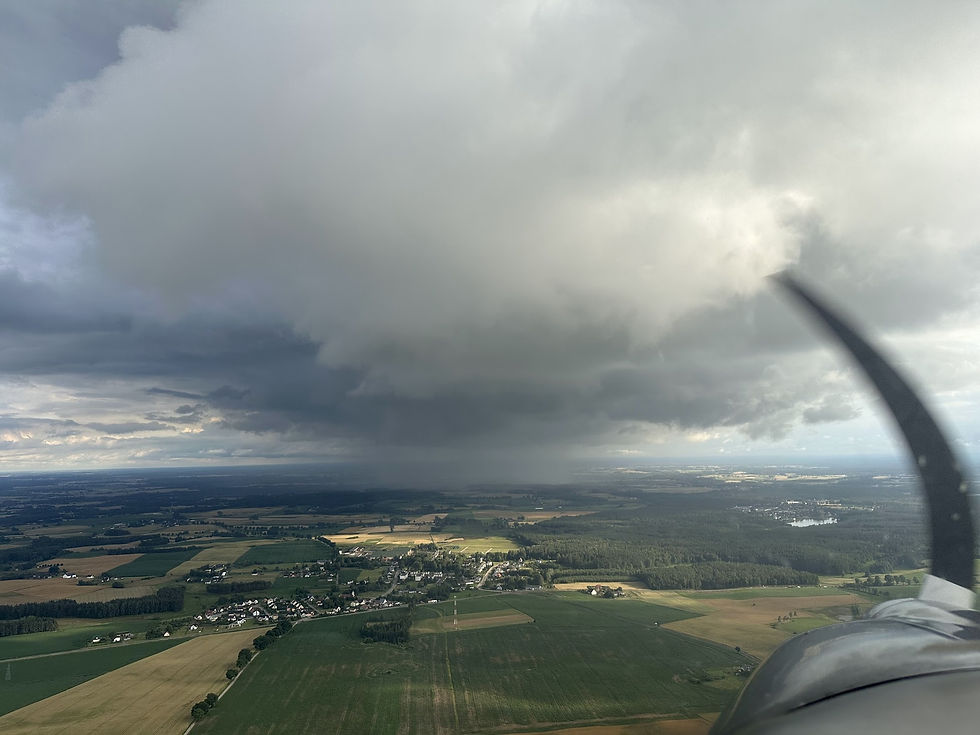
Pressure to get home can make small improvements seem more convincing than a worsening overall picture. Notice if your reasoning begins with the hire period ending or someone waiting at the destination. Those pressures are real, but neither changes the height of the terrain. Decide what conditions would make you divert while you can still apply that decision calmly.
Your own experience and recent practice also belong in the assessment. A newly qualified pilot navigating an unfamiliar CTR may face a high workload even in weather comfortably above the minimum. A flying school's operating limits or instructor's solo authorisation can be more restrictive than the general SVFR rules. Check them before assuming the clearance makes the flight available to you.
Before you request the clearance
Start with the current aerodrome observations, forecasts and relevant notices. Read the Aeronautical Information Publication and charts for the zone's procedures, including local SVFR restrictions and available routes. Consider the likely weather along the entire flight, especially any part beyond the CTR where different VFR requirements apply.
Work through the route at the heights you can actually use. Include obstacles and any congested areas, together with a safe way to turn away or land elsewhere. Consider what you would do if the clearance were delayed or the weather deteriorated. If the plan only works when every assumption is favourable, choose a less demanding option.
Make the request early enough to remain outside controlled airspace while it is considered. Give ATC the information needed to understand your position and intended operation, and provide an honest flight-visibility report when requested. Read back the clearance and check that you can comply with its route, level and other conditions before accepting it.
Once flying, keep comparing the conditions with your plan. If they begin to remove your safe options, tell ATC and act early. If you become unable to maintain visual conditions or need urgent assistance, communicate the problem clearly and use the appropriate urgency or distress call. Avoid spending the remaining time trying to make an unsuitable flight fit the clearance.
Special VFR is most useful when the permitted route remains clearly flyable and leaves you room to respond if conditions change. If you are uncertain about either, waiting or diverting gives you the opportunity to fly again in more suitable conditions.
SVFR decisions draw on the Air Law and Meteorology knowledge you develop during PPL training. The video below introduces Easy EASA's online theory course, where you can build that understanding and practise applying it to exam questions before discussing local SVFR procedures with your instructor.


Comments